Spring, Summer, and Fall

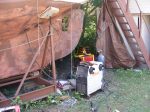
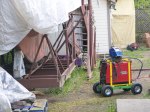
This warm season provided some time for work on our refit, and also gave us some great sailing weather for our new family picnic vessel, a 16′ Wayfarer.

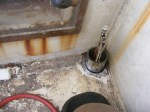
It was discovered in the early spring that a bronze bushing had been used in the rudder tube. This started a galvanic reaction eating at the rudder tube and rudder stock. Ultrasound picked up the thinning, the rudder was impossible to swing. Complete removal and replacement was necessary, and was completed with modern materials. The job was well within our means but a huge job to add to an already long list

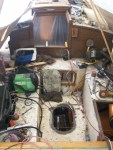
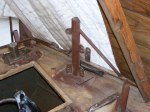
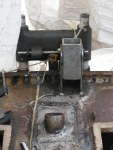
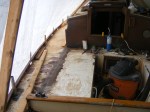
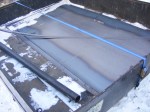
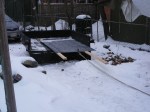
I managed to complete the installation of a fuel fill, water fill setup inside the cockpit which will make for easy jerry-canning underway. The fills rest under what will be the new cockpit seat tops of wood slats on a stainless frame. A complete weld-out of the cockpit was under taken including installation of all fabricated hatches, cockpit sole replating harness tie-off points and installation of mainsheet horses, bilge pump outlet plate and last but certainly not least the rudder tube/rudder heel and new welded self steering mounts.

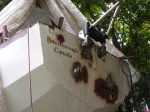
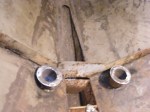
The rudder tube alignment was critical given that the heel must align with the entire rudder tube, piercing both the hull beneath the waterline and the deck just inward of the transom. The total length of aligned bearings was over 10 feet. The tube it’s self is 2 1/2″ sch 40 pipe, passed through hull and deck with doubler plates and multiple struts  to deck and hull. It took an amazing amount of fussing around to have dead straight but it’s good now. The heel and the upper rudder tube have UHMW polyethylene bearings which i have already turned with a complete spare set as well
Posted in Uncategorized | Leave a comment

Shop Work- winter and spring 2015

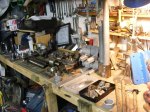
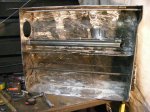
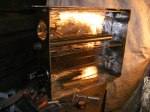
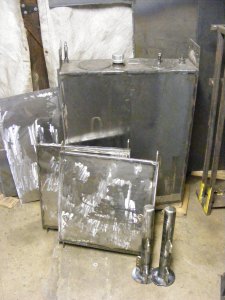
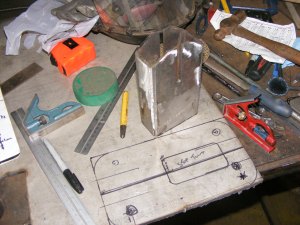
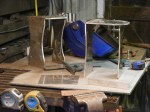
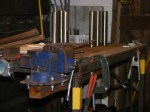
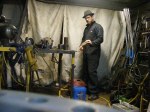
The winter time found me huddled in the small shop most evenings, after my son fell asleep, puttering on small components of our vessel. A 24 gallon diesel tank was built from steel with a tall narrow design to fit in a box keel. It has a sloping bottom, sump with clean out, a deep fill, and will supply a 12 gallon day tank, which in turn gravity feeds the Volvo MD-2

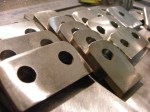
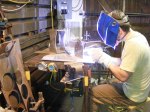
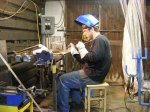
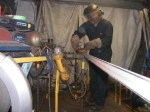
Lazarette and cockpit locker hatches have been fabricated from steel as well, TIG welded 1/8 plate with flat bar enforcing the convex curvature of the hatch tops. The main forward cabin hatch was fabricated with 5052 Aluminum, TIG welded on outside seems.. which oddly i don’t have a photo of.

Posted in Uncategorized | Leave a comment

Lead Ballast

With the scrap steel and concrete ballast removed at a weight of 250-300lbs per cubic foot, the time came to purchase the new lead ballast at a weight of 708 lbs per cubic foot.

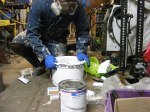
My original intention was to obtain scrap lead, weld my own brick molds, and then melt and mold my own lead bricks (with proper PPE).  But i’m ready now, and haven’t time to spend on such a process(work, family, boat). A local amateur boatbuilder steered me towards Mars Metals in Burlington Ontario where I ordered 100 of their 2x4x6 bricks of lead (2000lbs), and 380 lbs of lead shot. These will be secured in a West System slurry, the shot filling all voids between bricks and keel plating, no lead will touch steel. I have some scavenged lead of my own in odd sized bricks.

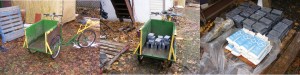
I rented a van with a 3600 lb capacity and drove the 2 1/2 hours to Burlington, through Toronto down the busiest highway in the country, 10 minute turn around at the other end, and then back to unload my loot into the cargo trike 400 lbs at a time.. down the lane and into a stack where our small crane will swing it aboard as needed. A couple months wages in a couple square feet of metal… thrilling.. really, not sarcastically.

Posted in Uncategorized | Leave a comment

Paint- a turning point

A turning point was reached in the internal work of our fine vessel. Welding is 95% complete with only a few jobs in the cockpit and transom to complete. As fall has arrived the painting of Eleanor Tarr’s interior metal work has begun ( starting at the bow and coming 7 of 12 frames aft.

Paint prep consists of a full wire wheeling/complete rust-crust removal as well as the extremely tedious removal of tar coating covered in the refit portion of this page, and then a thorough clean with an acetone.

The paint then consists of: 1 coat PPG Sealer (surface tolerant 0% VOC 2 part epoxy sealer) followed by 3 coats of PPG Amerlock 2 (high build 2 part surface tolenrant epoxy paint), alternating between white and grey to ensure coverage, and a 4th coat of Amerlock 2 on all frames, stringers, all corners and intersections of framing and on all plating beneath the waterline. The PPG paint system is the same as used on US Navy and Coast guard vessels among may other steel vessels.

After all welding and painting is complete, the hull will be insulated above the waterline with polystyrene board, trimmed smaller than it’s intended surface, and sealed in place with polyurethane foam. This leaves each insulating panel some what removable. As our vessel ages there may be need for repair or alteration (welding) which risks fire should the insulation remain in place. This is the primary (and possibly only) disadvantage of sprayed polyurethane throughout hull.

Posted in Uncategorized | Tagged , , , | 2 Comments

Repower

To date, Eleanor Tarr had a gasoline axillary engine that had been removed in the summer of 2013. I have been (and still am) keeping my eye on the electric yacht motor scene, but until that seems a little more feasible for a cruising yacht i have been saving my pennies for a diesel engine 15-20 hp.

A new engine was going to set us back close to ten thousand bucks, and that had been my plan until i heard rumour of an older, rebuilt volvo diesel. To be honest ten thousand bucks is not the sort of money i have to spend, particularly on an engine, that same money could/would/will go so much farther if spent on rigging, sails etc.

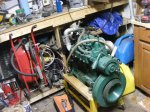
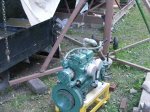
So it so happened that mid august i heard of a 2 cylinder volvo diesel for sale, a couple of hours away. So i took off with my trailer at 4:00 am and headed down to the shore. What i found was a late 60’s or early 70’s volvo MD2, 17 hp, rebuilt and never reused, hand cranked with decompression levers for a song of a price. So home we drove together, out and onto a cart in the shop to have a starter added and to be given a thorough going over.

Posted in Uncategorized | Leave a comment

Winch Bases, and Cockpit Coaming dreams

It goes like this: Cockpit cushions rust the steel they sit on, so i would like timber slats raised of the steel with stainless risers to provide a space for air, and water drainage, and cockpit locker lids. The whole assembly adds 1 1/2″ to the cockpit seat. The cushion was/is 2″ thick. We may not have new cushions, timber slats may prove satisfactory on our behinds ..but perhaps we might and that’d sit us up 2″ too high beside the cockpit coaming. The cockpit comaing in our case often keeps quite a bit of water out, and quite a bit of sailor in.

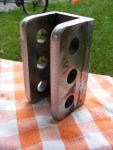
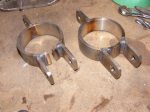
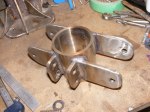
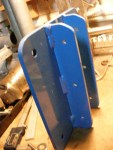
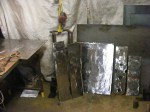
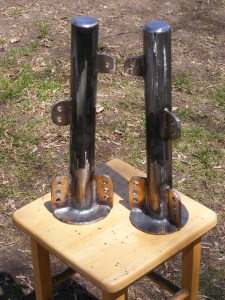
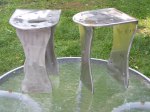
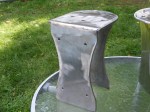
So i think that increasing the cockpit coaming height by 2″ is a good decision either way the seats end up. Because the coaming is higher the winch stands would have to be raised as well. Six or seven years ago i made some oak stands, and they look alright, but the would need to be altered and where the cetol finish had thinned, the oack had check and split. Since i work in metal these days i decided to cut/weld some up from a large sheet of 1/4″ 304 stainless steel plate i had. They still need a final polish but they look good and solid. Plasma cut, and TIG welded (gtaw.)

Posted in Uncategorized | Leave a comment

Deck Welding

With much of the below-waterline welding complete, my attention has turned to the deck and bulwark  work in the first week of holidays.

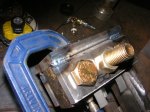
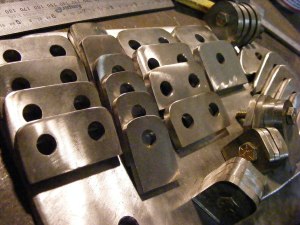
Stainless steel stanchion bases i constructed in the shop were welded to the deck and bulwark cap using 1/8″ 309l rod. Half way in between each stanchion base i welded an upright stainless bracket to attach the timber toerail/bulwark, th top of each bracket is strong point attachment for blocks, running gear, fenders or whatever else.

In the cockpit numerous deck fills were above what is to be the quarter berth, patches were cut and the holes were filled. I removed the ill placed deck fills with a 5 second blast from a propane torch, this heated the steel and the 5200 let go. On the on the aft of the deck numerous holes had been cut for various wire-way arrangements, all failures, these too had to be patched.

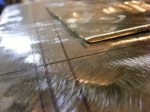
The top of the bulwarks (3-5″) are met with a boundary bar, a piece of 3/8 by 1 flat bar tacked every 6″ or so the length of the boat. Water had of course penetrated between tacks and caused rusting and rust streaking. I chipped out the two 36 ft crevices and proceeded to weld solid ( 1/8″ 6011). I burned up a whole box by the time this job was done.. hot. smoky. It was then to ground down, and flap wheeled, painted with a cheap primer (to be blasted and epoxy coated.)

Two new chainplates were  constructed including two compound bends or 5/16 x 1 1/2 steel, then welded 1/2″ aft of existing main chainplates. We may/probably will end up with a double spreader rig, now was the time to add them if ever. I used a 3×8 from my brother and law to correct on slight overbend (see pictures)

Posted in Uncategorized | Leave a comment

Hot Hot Heat, a warm summer week, plasma cutting and welding

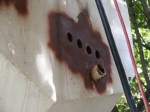
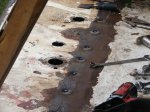
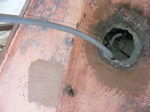
Some scheduled time off work arrived, my family departed on a get away and i jumped into our fine vessel for some below waterline welding and cutting. The weeks jobs included removal of every through hull (welded pipe to hull) and replacement and/or relocation of that through hull as well as the subsequent patching of the hull. The 1 1/4 cockpit drains were replaced with thick walled 2″ pipe
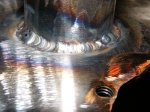
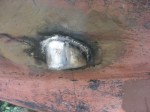
I chose to use sch 80 pipe nipples (thick wall) with 1/8″ doubler “donut” plate on the outside.

A doubler plate (a second layer of steel which is generally asking for trouble) is a controversial thing and an external one even more so. After much research and review I found that workboats, tugs etc often had this arrangement, when well sealed would provide the through hull with incredible support with any weld pulling outwards.. so this is what i did.
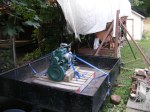
I patched the hull in the same manor since the largest of the patches was 7″ round, i overlayed the patch by 1/8″ (hull plate thickness) a little clunky looking but as strong as a dumptruck.
The following pictures show some of the work, though i took very few nearing the completion of these projects as my family’s return was imminent, and my body was growing weary.

Posted in Uncategorized | Leave a comment

Spring 2014

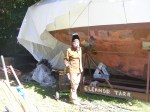
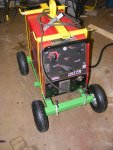
In a normal great lakes sailing season this would be the time in which to commission and launch a sailing craft, here in Eleanor’s backyard boatyard it’s the time of year where winter doors are removed from the shop, the 220v power is re connected, the welder carts wheels are inflated and hull work begins.

This May saw the final remnants of tar removed with close to 100 hrs total, the final two thirds of which was done with a small pick and propane torch. The tar is gone 99.5% of it anyhow.

Later in May i plasma cut 4″ holes in the hull plating for the speedlog, and depth sounder. In  these holes Dikin-Shinas designed damage limitation pots which provide physical insurance against through-hull failure. A little vauge yes, sorry it’s and idea from Jill Dikin Shinas’ lastest book how not to build a boat, a marvelous book in which i don’t wish to give away the plot.

It’s now the middle of June, this month i removed the mahogany cockpit comings. The coamings were fixed to the cabin sides, re-enforced by the winch stands and the fixed the the aft coaming which is of steel. The coaming was then screwed through the deck from beneath into the end grain. The wood had rotted around the screws and of course rust followed the screws into the deck. The plan is to remove rust, weld holes over, weld stainless flat bar along the length of the cockpit with bolt holes for a new mahogany coaming.

Posted in Uncategorized | Leave a comment

Winter of 2013/2014

A cold winter kept me out of the vessel, and in the warm shop.

Posted in Uncategorized | Leave a comment