Schools Out- 30 feet of freedom

We are headed back off the grid, on to the sea, and into full time freedom… I have wrapped up my final days with my employer. We (Tim, Alli and 5 year old Orion) plan on departing this summer on a blue water voyage of unknown destination. I now have a month before sandblasting to complete the interior, systems, rig and engine install. Being a follower of Adventure Builders principles this should be no problem. Life is Flying by!!!! Launch late june, or early July in Lake Ontario

Here is what the fine vessel looks like now. 3 Coats of West System epoxy inside and out of the 1 1/2″ Honduran Mahogany cabin sides. Each panel of the interior has been fitted, removed, painted 2-3 coats all sides and then installed. Alli Has much/most of the interior upholstery complete. Mahogany doors complete each of the lockers shown.


Time-Family


Posted in Uncategorized | Leave a comment

Handholds

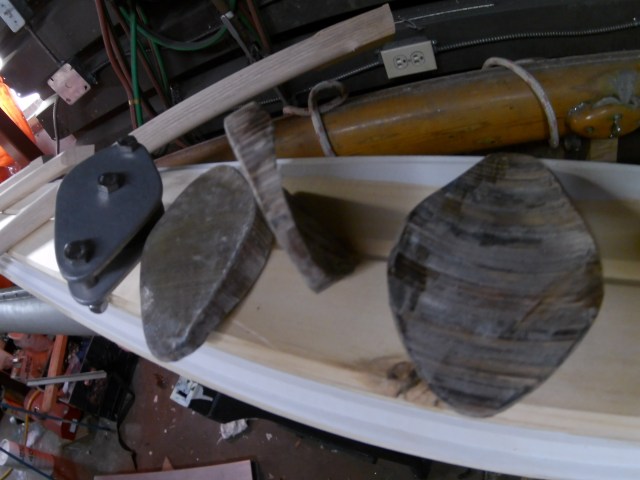
I have strengthened the interior bulkheads, and the coach roof.. and added some great hand holds. I made a template of pine, and then cut these from a 10″ ash board.

Posted in Uncategorized | Leave a comment

Water Tanks

Two wedge shaped stainless water tanks have been fabricated with a combined capacity of over 40 gallons.

The lower seems of the tank were welded (TIG) inside and out, the top was the welded from the outside once the tank interior had been purged 100% with argon.


The tanks were pressured to 5 psi and soap tested. 0 leaks… so i did it twice. Thankfully I’d had some recent practice at work on a very large stainless hydraulic tank.


The tanks are fastened in with rubber padding, bolt pads, and finally the ash framing that supports the bunks. The install should be sufficient..hopefully even in the event of a roll over.

Posted in Uncategorized | Leave a comment

New Boom

I have constructed a new boom from 4″ schedule 40 aluminum pipe, with stainless caps to accommodate hearty hardware fastenings (outhaul, gooseneck, mainsheet). The caps were welded and then turned on lathe.

Fastenings for caps and sail track have been tapped into the aluminum pipe. Below the two booms are shown together.

The spruce boom vang attachment is shown (strap chafe rear). The new attachment has a doubling sleeve, and a stainless compression tube for 3/8″ stainless bail and through rod.

The next obstacle became mounting hardware with flat mounts, to round pipe. After a couple of experiments, I drilled an appropriate diameter hole in a bunch of scrap marine ply. I then laminated them all together with the holes lined up. I then split the circumference in three and shaped them to fit my shop-made blocks. The were then wrapped in a sheathing of 10 oz fiberglass cloth set in West System epoxy.

P1000003 (3)

One other experiment that proved time consuming, was the construction of a mold, and the the casting of a “fairing block” from extra slow cure West System and chopped fiberglass cloth. The one of this design I made will support the reefing winch

P1000004 (3)

The new boom and mast will be painted in ( it’s here.. but the weather isn’t) PPG Pitthane-Ultra which I have had tinted to “onion skin” not to be fake wood.. but to keep our eyes from burning ..and yearning for our spruce spars.

Posted in Uncategorized | Leave a comment

Tusket Garvey

In the fall of 2017 I combined a number of existing designs for utility dorys and came up with the “Tusket Garvey.” After a 1′ to 1″ bristol board model the design was finalised. The 16 ft by 6’6 craft was fabricated over 5 weeks inside my 10 x 22 shop, tight to say the least

With a Hobart 250 and spool gun this vessel is constructed of aluminum, 1/8″ sheet with 1/4″ transom and bow door.


Posted in Uncategorized | Leave a comment

Beginning to feel like home

I have noticed lately that if I move from a fixed spot in the boat, I can feel where the parts of the interior used to be. Muscle memory from clambering and clawing through the cabin in sloppy seas. It’s nice to have old spots back, and I’ll have to learn where the new hand holds are.

It has been a busy month again, constructing the interior, and then disassembling, removing and painting all pieces all sides 2 coats, tops 3. An then a re install. Much of the interior is roughed in. No systems have been run, though conduit has been.

Our Dickinson Caribbean Stove and Newport heater have arrived. It is nearly time to install them. The galley cabinet needs more paint and the maple countertop ( currently one rough board) Stove at bulkhead, and then moving aft, sink and the refrigeration.

Posted in Uncategorized | 2 Comments

New Mast Arrives

Our new aluminum mast has arrived. It was purchased partially completed (due to our budget) from Klacko Spars. It is their K35 extrusion, with welded masthead and compression tubes. A beautiful job and mast!!

The reason for our switch to an aluminum mast is as follows. We wanted to have two forestays, one at the original fractional point (13/16) and a masthead in addition. The inner fractional one carrying our harken furler. The outer masthead wire left bare, for our large genoa or storm jib. The sitka spruce mast we have tapers wonderfully at the top, and thus is ill suited to a masthead rig of any sort. I briefly considered modifying the spruce mast, which i’m sure could be done, or building a new wood mast. Time, and my skill-set ( i am a metal worker/welder) steered me to the aluminum extrusion. The redesigned rig ( of which i will at some point post the complete drawings) now sports double spreaders. This is because with a single set of spreaders, our taller mast (39’8″) and our narrow beam (9’6″) make it impossible to maintain the 12 degrees necessary at the shroud-masthead intersection. The double spreaders relieve this, allow for a shorter spreader and healthy staying angles throughout.


Posted in Uncategorized | Leave a comment

First Sign of Creature Comforts

The beginnings of an interior, some creature comforts, are reappearing aboard Eleanor Tarr.

Using the original interior of spruce ply as templates, new bulkheads and berth sides were cut from 1/2″ marine plywood and installed. To support these I milled and cut to size 1x 1 1/2″ ash framing materials from a Lakefield mill. The port side bunk is to pull out 14″ making it a small double berth. I’m doing this with sliding ash beams running and riding underneath the permanent framing as suggested by Fred Bingham.


Each bunk will be above an 18 gallon fresh water tank. Our 100 gallon fresh water capacity is being based on the liberal estimation of 1 gallon per person, per day, which we have found as a cruising couple to be much more than enough, though we are now joined by a small boy in edition. This will give the vessel a range of 33 days. Our longest passage to date has been 35 days which could re-occur. This capacity should be adequate knowing that we will have a manual water maker in addition.

Posted in Uncategorized | Leave a comment

Diesel Engine and Tanks in place

It was a clear enough week to keep the tarps off, and with the interior cleaned it was an ideal time to install the diesel tanks. All went quite smoothly, I eventually ran out of excuses not to hoist the engine up.

That was a bit more of s struggle but it was up and in in half an hour. Some counter weight was required on the crane 300 lbs to support the 450 lb engine which hung 9ft from the cranes centrepoint.

Posted in Uncategorized | Leave a comment

Cabin Sole

The cabin sole (floor) had originally been constructed from 1/2″ spruce ply. The thickness was nearly sufficient but the sole was tired and smelled of the old tar lining.

I looked into using a marine ply with a teak and holly veneer but it looked to be more “yachty: and quite expensive. Our vessel is a working family vessel, where things will dropped, sand will be scuffed etc. Inspired by shipwright Tim Lackeys work, I decide to laminate a thick hardwood veneer to marine ply.

I decide to use 3/8 ply wood and laminate it to 1/4″ of ash. A local ash was available rough from a mill near by. After stickering and drying it, it was jointed then resawed  on the bandsaw, and then planed it to a thickness of 1/4.

The original plywood sole was used as a pattern. The new plywood was laminated to the ash strips with thickened West System epoxy, and held in place by a huge number of clamps, weights and brad nails.

And now to the finishing stages.

P1000043 (3)

Shown with second coat of thinned Epiphanes Gloss

Posted in Uncategorized | Leave a comment